
Shanghai Newdi Navigation Technology Co.,Ltd

Precision GNSS RTK Receiver Solutions for Angola's Infrastructure

Empowering Angolan engineering and agriculture with high-accuracy positioning and automated measurement systems to drive national development.

Precision GNSS RTK Receiver Solutions for Angola's Infrastructure

Integrating advanced spatial data acquisition with local Angolan terrain requirements to ensure centimeter-level accuracy in challenging environments.

The State of Geomatics in Angola

Analyzing the intersection of rugged topography and modern measurement needs.

Angola's current industrial landscape is characterized by a rapid expansion of mining and road infrastructure. However, the diverse climate—from the arid south to the humid tropical north—poses significant challenges for traditional surveying equipment, which often suffers from calibration drift under extreme thermal fluctuations.

In the agricultural sector, particularly in the Huambo and Bié provinces, there is a growing shift from manual land marking to the adoption of gps diferencial systems. This transition is critical for optimizing land use and increasing crop yields in a region striving for food security.

Despite the progress, many local firms still rely on legacy hardware. The gap between traditional optical methods and satellite-based RTK technology has created a demand for robust, all-in-one systems that can operate in remote areas with limited cellular connectivity.
Evolution of Measurement Technology in Angola

From manual chains to autonomous satellite guidance.

Market Development History

Before 2010, the Angolan market was dominated by manual theodolites and early-stage total station units. These tools were essential for post-conflict reconstruction but lacked the speed required for large-scale urban planning in Luanda.

Between 2011 and 2018, the introduction of basic GNSS technology allowed for faster boundary mapping. However, the lack of a dense CORS network meant that surveyors had to carry bulky base stations to every single site to achieve necessary precision.

Since 2019, the convergence of IoT and satellite positioning has led to the rise of the auto steer tractor in commercial farming, transforming the agricultural landscape by reducing overlap and fuel consumption.

Future Development Trends

Multi-Constellation Integration

Future adoption will shift toward receivers that simultaneously track Beidou, GPS, and GLONASS to overcome signal blockage in dense tropical canopies.

Cloud-Based RTK Networks

The shift toward Network RTK (NRTK) will eliminate the need for local base stations, allowing Angolan engineers to access corrections via 4G/5G networks.

Autonomous Site Grading

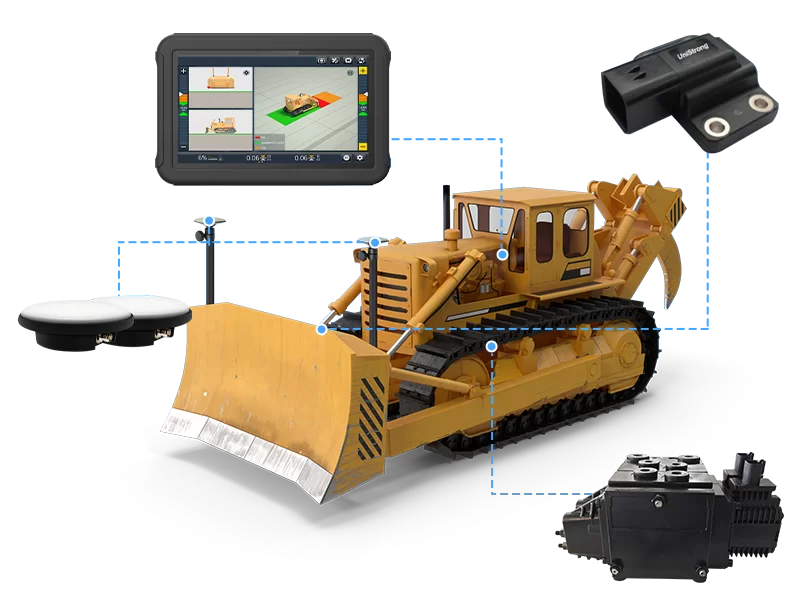
We expect a surge in machine control systems where surveying data is fed directly into construction machinery for automated excavation.

Future Trends and Strategic Outlook

Predicting the next 5 years of precision instrumentation in the African market.

AI-Driven Surveying
Integration of AI for automatic feature recognition in terrain mapping, reducing manual post-processing time.
Agricultural Automation
Expanding the use of autonomous steering to mid-sized farms to maximize land efficiency in Angola.
Hybrid Positioning
Combining GNSS with Inertial Navigation Systems (INS) to maintain accuracy in tunnels and deep valleys.
Digital Twin Cities
Using high-precision data to build 3D digital twins of Luanda for smarter urban management.

Industry Outlook

The trend in Angola is moving toward a "Connected Field" ecosystem. Based on regional search data, there is a significant increase in queries for low-cost but high-reliability RTK systems, indicating that the market is expanding from large enterprises to small-to-medium scale contractors.

Over the next 3-5 years, we anticipate that the integration of satellite-based augmentation systems (SBAS) will become standard, further reducing the dependency on physical base stations across the Angolan interior.

Local Application Scenarios in Angola

Practical deployments of precision instruments across Angolan sectors.

01. Mining Boundary Mapping in Lunda Norte

Using high-precision GNSS receivers to define concession boundaries in diamond mining areas, ensuring legal compliance and avoiding land disputes.

02. Road Expansion Projects in Luanda

Implementing total stations and RTK systems for the precise layout of new highway interchanges, managing steep gradients and urban constraints.

03. Precision Agriculture in Huambo

Deploying auto-steer tractor systems to optimize maize and soybean planting, reducing seed waste by 15% through precise row alignment.

04. Hydroelectric Dam Monitoring

Utilizing differential GPS for long-term deformation monitoring of dam walls to ensure structural integrity and public safety.

05. Coastal Erosion Mapping in Benguela

Applying RTK-based surveying to monitor shoreline changes, providing critical data for coastal protection and urban planning.

Brand Story

Global Development Journey of Shanghai NCT Navigation Technology Co., Ltd.

Foundational Innovation

Established with a mission to democratize high-precision positioning, focusing on bridging the gap between industrial needs and technical complexity.

RTK Technology Breakthrough

Developed proprietary algorithms to enhance signal stability in challenging environments, setting a new standard for efficiency in surveying.

Agricultural Expansion

Successfully launched the auto-steering series, enabling farmers worldwide to transition from traditional methods to precision agriculture.

Global Market Integration

Expanded operations into Africa and South America, tailoring products to survive the harshest climates and most demanding terrains.

Commitment to Sustainability

Currently focused on reducing the carbon footprint of infrastructure projects through extreme precision and waste reduction.

Comprehensive Precision Portfolio for Angola

Integrated hardware and software solutions designed for the Angolan industrial environment.

Frequently Asked Questions in Angola

Expert answers to common technical and logistical queries.

How does the GNSS RTK receiver handle signal loss in remote Angolan forests?

Our receivers utilize multi-constellation tracking and internal IMU sensors to maintain a high-accuracy heading even during temporary satellite signal occlusion.

Can the auto steer tractor be installed on older machinery models used in Angola?

Yes, our systems are designed for universal compatibility, featuring adaptable steering controllers that can be retrofitted to most mechanical and hydraulic tractor systems.

What is the difference between a total station and RTK for road construction?

A total station provides absolute precision over short distances via optical lines, while RTK allows for rapid, large-scale mapping across several kilometers without needing line-of-sight.

How often should surveying equipment be calibrated in the Angolan climate?

Due to high temperature variance in regions like Namibe, we recommend a professional calibration check every 6 months to ensure consistent accuracy.

Does gps diferencial require a constant internet connection?

While NRTK requires internet, our differential systems can operate via UHF Radio links, making them ideal for deep inland areas of Angola without GSM coverage.

What are the main benefits of upgrading to modern surveying equipment?

Upgrading reduces human error, accelerates data collection by up to 70%, and significantly lowers the cost per hectare in agricultural and mining operations.

Request a Technical Consultation

Our engineers are ready to provide customized precision solutions for your projects in Angola.

Contact Us Now