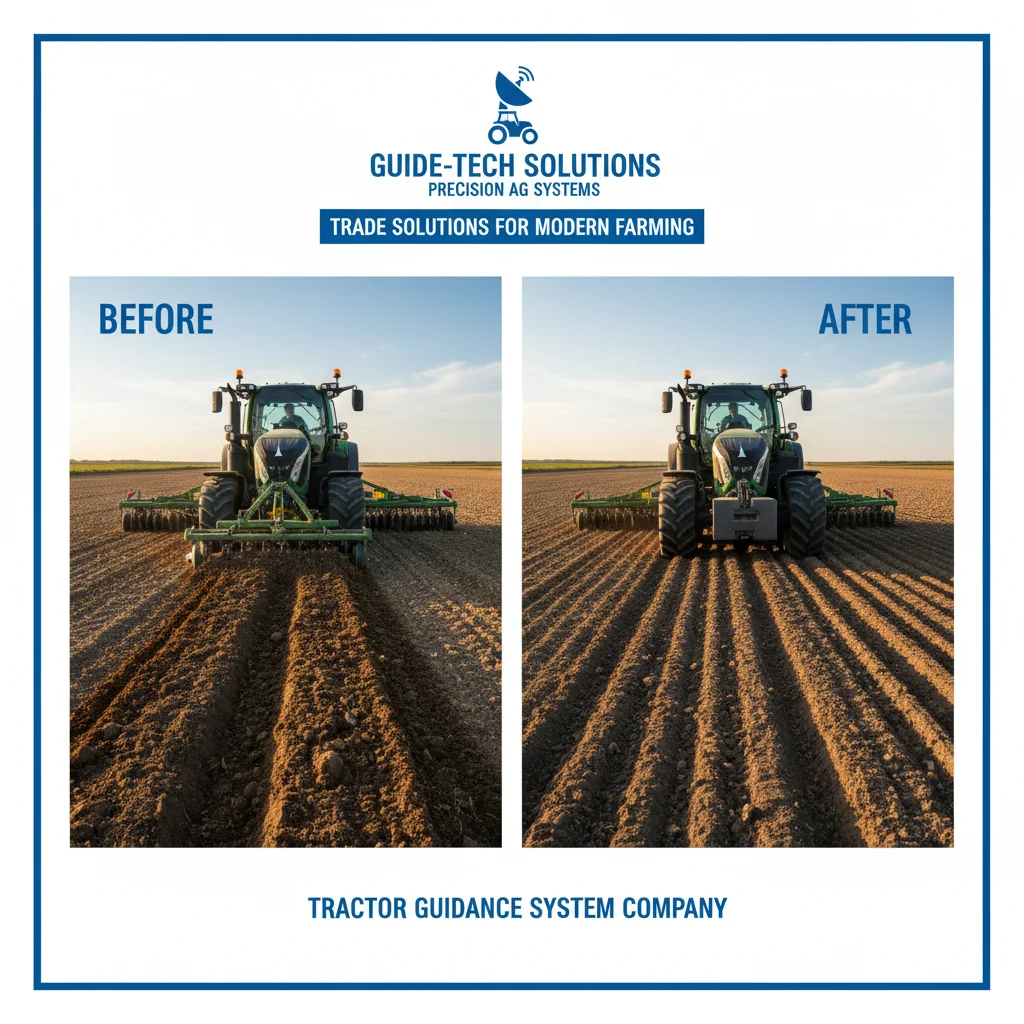
The global push for precision agriculture has transformed how farmers approach land management, shifting from intuitive methods to data-driven precision. At the heart of this evolution is the need for reliable positioning and steering infrastructure, where the role of a China gps auto steer for farm tractors supplier becomes pivotal in providing the hardware and software necessary to reduce overlap and optimize crop yields.
Modern agricultural operations face the dual challenge of increasing food demand and shrinking arable land, making efficiency no longer optional but a necessity. By integrating high-precision GNSS base stations and steering controllers, farmers can ensure that every pass of the tractor is mathematically optimized, reducing fuel consumption and minimizing the waste of expensive seeds and fertilizers.
For those seeking to modernize their fleet, partnering with a professional China gps auto steer for farm tractors supplier ensures access to integrated systems like the M2 GNSS Station, which streamlines the setup of RTK networks. This technology allows for centimeter-level accuracy, transforming the tractor from a simple mechanical tool into a precision instrument for sustainable farming.

The Role of M2 GNSS in Precision Agriculture
The M2 GNSS Station serves as the foundational infrastructure for any high-precision steering system. By integrating the receiver, radio, and battery into a single unit, it eliminates the complexity typically associated with RTK base stations. This all-in-one architecture is essential for a China gps auto steer for farm tractors supplier to offer a solution that is accessible to farmers who may not have professional surveying backgrounds.
By providing stable, real-time kinematic (RTK) corrections, the M2 ensures that the auto-steer system on the tractor remains precise within millimeters. This eliminates the "drift" common in standard GPS systems, allowing for perfectly straight rows and precise headland turns, which directly translates to lower operational costs and higher crop uniformity.
Streamlining Field Deployment and Efficiency
Traditional GNSS base stations often require a tedious setup process involving external batteries, multiple cables, and separate radio transmitters. For a busy farming operation, this downtime represents a significant loss in productivity. The M2 GNSS Station addresses this by removing the need for cumbersome external accessories, allowing the operator to deploy the station in a fraction of the time.
This streamlined approach increases work efficiency by up to 3 times compared to conventional external radio solutions. When a tractor's auto-steer system can be activated almost instantly upon arriving at the field, the window for optimal planting or harvesting is maximized. This agility is a key selling point for any leading China gps auto steer for farm tractors supplier.
Furthermore, the reduction in hardware components means fewer points of failure. In the middle of a harvest, a faulty cable or a dead external battery can halt an entire operation. The integrated design of the M2 minimizes these risks, ensuring that the high-precision correction stream remains uninterrupted throughout the workday.
Technical Core of High-Precision Positioning
The technical superiority of the M2 station lies in its 1408-channel tracking capability, powered by NebulasIVTM. This allows the system to track multiple constellations simultaneously, including GPS, GLONASS, Galileo, BeiDou, QZSS, and NavIC. For a China gps auto steer for farm tractors supplier, offering multi-constellation support is critical for maintaining a lock in challenging terrains.
Precision is quantified by the RTK accuracy, which reaches ±(8+1×10⁻⁶D) mm horizontally and ±(15+1×10⁻⁶D) mm vertically. This extreme level of detail ensures that the auto-steer system can maintain a line with absolute consistency. A reputable China gps auto steer for farm tractors supplier prioritizes these parameters to avoid overlap, which can lead to over-fertilization and soil compaction.
Beyond raw tracking, the M2 utilizes advanced multipath mitigation algorithms. These algorithms filter out signal reflections from nearby trees or buildings, ensuring that the correction data sent to the tractor is clean and accurate. This makes the system reliable even in wooded or suburban agricultural zones where signal interference is common.
Operational Performance and Investment Return
Investing in a professional GNSS infrastructure is about more than just technology; it is about the return on investment (ROI). By reducing the power consumption by 50% through advanced electronics design, the M2 GNSS station lowers the total cost of ownership. For those sourcing from a China gps auto steer for farm tractors supplier, the focus is often on maximizing uptime and minimizing overhead.
The efficiency gains are tangible. Reduced overlap in spraying and seeding can save thousands of dollars in input costs per season. Additionally, the ability to operate for up to 15 hours on a single charge (with a 24000mAh battery) means the base station can run an entire shift without requiring a battery swap, keeping the tractors moving.
Efficiency Ratings of GNSS Solutions for Auto Steer
Versatile Transmission for Diverse Environments
One of the most critical aspects of a China gps auto steer for farm tractors supplier solution is the ability to transmit corrections regardless of the local infrastructure. The M2 GNSS Station employs a hybrid transmission strategy, supporting both UHF radio and a built-in 4G modem. This means that in remote areas with no cellular coverage, the 5W UHF radio can push signals up to 8km in open areas.
Conversely, in areas where 4G connectivity is available, the station can transmit corrections via TCP/IP servers. This versatility ensures that the tractor's auto-steer system never loses its precision lock, regardless of whether the farm is in a dense wooded valley or an open prairie. The addition of LoRa support further increases interoperability with other smart farming sensors.
Rugged Durability for Harsh Farming Conditions
Agriculture is an environment characterized by dust, moisture, and extreme temperature fluctuations. Equipment provided by a China gps auto steer for farm tractors supplier must be built to survive these conditions. The M2 GNSS Station is IP67 rated, meaning it is fully waterproof and dustproof, allowing it to operate reliably during heavy rain or in the middle of a dusty harvest.
Temperature resilience is another key factor; the M2 is engineered to function in environments ranging from -30℃ to +65℃. This ensures that from the freezing early mornings of spring planting to the scorching heat of mid-summer, the base station remains stable.
Physical durability is further enhanced by a chassis designed to withstand 2m pole drops. In the fast-paced environment of a farm, accidents happen. Having a base station that can survive a fall without losing calibration is essential for maintaining continuous operation and avoiding costly replacements.
Comparing Integrated Bases vs Traditional Systems
When analyzing the value proposition of a China gps auto steer for farm tractors supplier, it is helpful to compare the M2's all-in-one approach with traditional radio solutions. Traditional systems often involve a separate GNSS receiver, a standalone radio, and a separate power source. This creates a "cable nightmare" and significantly increases the time it takes to get the system online.
The M2's integration doesn't just save time; it optimizes the entire power chain. By utilizing a Linux-based OS and optimized electronics, the station can provide up to 50 hours of static working time. This is a massive leap over traditional systems that require frequent battery swaps or external power generators.
Ultimately, the shift toward integrated GNSS stations represents the digital transformation of the field. By simplifying the hardware, farmers can focus on the data and the results rather than the technical troubleshooting of their positioning equipment.
Comparison of M2 GNSS Station and Traditional Radio Base Solutions
| Feature Dimension |
Traditional Radio Solutions |
M2 GNSS Station |
Impact on Farm ROI |
| Setup Time |
High (Cables/Batteries) |
Ultra-Low (All-in-One) |
Increased Uptime |
| Work Efficiency |
Standard Baseline |
3x Improvement |
Faster Field Entry |
| Power Demand |
High / Multiple Sources |
50% Reduction |
Lower Op-Ex |
| Correction Method |
Radio Only |
Hybrid (Radio + 4G) |
Signal Reliability |
| Physical Bulk |
Multiple Accessories |
Single Integrated Unit |
Easier Logistics |
| Durability |
Variable/Component-based |
IP67 / Shockproof |
Reduced Downtime |
FAQS
The M2 eliminates the need for external cables and separate batteries by integrating everything into one unit. This simplification reduces setup time and increases overall field work efficiency by at least 3 times compared to traditional external radio solutions, making it an ideal choice for a China gps auto steer for farm tractors supplier to offer.
It utilizes 1408 channels and advanced multipath mitigation algorithms to maintain a high-quality GNSS lock. By tracking multiple constellations (GPS, GLONASS, Galileo, BeiDou, etc.), it ensures consistent RTK corrections even in wooded or suburban areas where signal blockage is common.
The M2's 5W UHF radio provides extensive coverage, reaching up to 8 km in typical open survey and farming operations. In more challenging environments, such as dense forests or suburban zones, the effective range is approximately 5 km.
Yes, the M2 includes a built-in 4G modem. This allows the station to transmit GNSS corrections via TCP/IP servers, providing a versatile alternative to radio transmission in areas with good cellular coverage.
The station is equipped with a high-capacity 3.65V 24000mAh battery. This provides up to 15 hours of continuous RTK operation at 5W output, and up to 50 hours of static working time, significantly reducing the need for field charging.
Absolutely. The M2 GNSS station is IP67 rated for waterproof and dustproof protection. It is specifically engineered to operate in extreme temperatures ranging from -30℃ to +65℃, ensuring reliability in any global climate.
Conclusion
The integration of high-precision GNSS technology via the M2 station represents a paradigm shift in how agricultural steering is managed. By combining 1408-channel tracking, hybrid 4G/UHF transmission, and a rugged all-in-one design, a professional China gps auto steer for farm tractors supplier can provide farmers with the tools to eliminate overlap, reduce input waste, and significantly increase operational efficiency.
As the industry moves toward fully autonomous farming, the importance of a stable and easy-to-deploy RTK infrastructure cannot be overstated. Investing in integrated systems not only provides immediate ROI through cost savings but also future-proofs the farm for the next generation of smart agriculture. For more information on upgrading your precision workflow, visit our website: www.nctnav.com